Saturday, August 6, 2011

Edit Distance

Problem: Given two text strings A = a1a2….an of length n and B = b1b2…bm of length m, you want to transform A into B with a minimum number of operations of the following types: delete a character from A, insert a character into A, or change some character in A into a new character. The minimal number of such operations required to transform A into B is called the edit distance between A and B. Give an algorithm for finding the edit distance from A to B.

Solution:
Recursion Relation: We recurse on m(i; j), the minimum number of operations to change A(1 : i) into B(1 : j). The relation is

image

Running Time: m has nm elements and evaluating each element takes O(1) time for a total running time of O(nm).

Balanced Partitions:

Suppose you are given an array of n integers {a1,……, an} between 0 and M. Give an algorithm for dividing these integers into two sets x and y such that the difference of the sum of the integers in each set, is minimized.

For example, given the set {2,3,2,7,9}, you can divide it into {2, 2, 7} (sums to 11) and {3; 9} (sums to 12) for a difference of 1.

Solution:
Recursion Relation: Consider just the set of the numbers {a1,…..,aj}. What sums can we make with that set or subsets of it? We can make

  • Any sums we could make with a subset of {a1,….,aj-1}
  • Any sums we could make with a subset of {a1,….,aj-1} + aj

So: Let Cij be 1 if a subset of {a1,…..,ai} adds to j and 0 otherwise. The recursion relation for Cij is

image

We find the value of j, let it be b, closest to

image

such that Cnj = 1. The minimum difference is 2(T - b).
Running Time: We need only let j go to nM since the integers are bounded. Therefore, the size of C is n2M and filling it in takes O(1) per entry for a total running time of O(n2M).

A dynamic programming solution to this problem is provided in this video tutorial by Brian C. Dean. It is problem number 7.

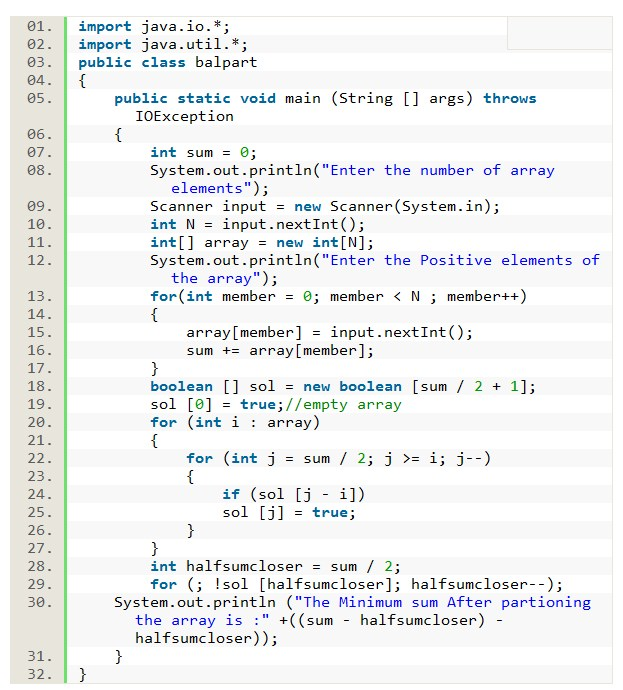
Algorithm:
Firstly this algorithm can be viewed as knapsack problem where individual array elements are the weights and half the sum as total weight of the knapsack.

1.take a solution array as boolean array sol[] of size sum/2+1

2. For each array element,traverse the array and set sol [j] to be true if sol [j - value of array] is true

3.Let halfsumcloser be the closest reachable number to half the sum and partition are sum-halfsumcloser and halfsumcloser.

4.start from halfsum and decrease halfsumcloser once everytime until you find that sol[halfsumcloser] is true

Box Stacking

Problem:  You are given a set of boxes {b1,……,bn}. Each box bj has an associated width wj , height hj and depth dj . Give an algorithm for creating the highest possible stack of boxes with the constraint that if box bj is stacked on box bi, the 2D base of bi must be larger in both dimensions than the base of bj . You can of course, rotate the boxes to decide which face is the base, but you can use each box only once.
For example, given two boxes with h1 = 5;w1 = 5; d1 = 1 and h2 = 4;w2 = 5; h2 = 2, you should orient box 1 so that it has a base of 5x5 and a height of 1 and stack box 2 on top of it oriented so that it has a height of 5 for a total stack height of 6.

Solution:

Recursion: Memorize over H(j,R), the tallest stack of boxes with j on top with rotation R.

image

Running Time: The size of H is O(n |Rj|) where R is the number of possible rotations for a box.For our purposes, |R| = 3 (since we only care about which dimension we designate as the \height") so |H| = O(n). Filling in each element of H is also O(n) for a total running time of O(n2).

Code:

   1: public static int stackHeight(ArrayList<Box> boxes) {
   2:         if (boxes == null) {
   3:             return 0;
   4:         }
   5:         int h = 0;
   6:         for (Box b : boxes) {
   7:             h += b.height;
   8:         }
   9:         return h;
  10:     }
  11:     
  12:     public static ArrayList<Box> createStackR(Box[] boxes, Box bottom) {
  13:         int max_height = 0;
  14:         ArrayList<Box> max_stack = null;
  15:         for (int i = 0; i < boxes.length; i++) {
  16:             if (boxes[i].canBeAbove(bottom)) {
  17:                 ArrayList<Box> new_stack = createStackR(boxes, boxes[i]);
  18:                 int new_height = stackHeight(new_stack);
  19:                 if (new_height > max_height) {
  20:                     max_stack = new_stack;
  21:                     max_height = new_height;
  22:                 }
  23:             }
  24:         }
  25:         
  26:         if (max_stack == null) {
  27:             max_stack = new ArrayList<Box>();
  28:         }
  29:         if (bottom != null) {
  30:             max_stack.add(0, bottom);
  31:         }
  32:         
  33:         return max_stack;
  34:     }
  35:     
  36:     public static ArrayList<Box> createStackDP(Box[] boxes, Box bottom, HashMap<Box, ArrayList<Box>> stack_map) {
  37:         if (bottom != null && stack_map.containsKey(bottom)) {
  38:             return stack_map.get(bottom);
  39:         }
  40:         
  41:         int max_height = 0;
  42:         ArrayList<Box> max_stack = null;
  43:         for (int i = 0; i < boxes.length; i++) {
  44:             if (boxes[i].canBeAbove(bottom)) {
  45:                 ArrayList<Box> new_stack = createStackDP(boxes, boxes[i], stack_map);
  46:                 int new_height = stackHeight(new_stack);
  47:                 if (new_height > max_height) {
  48:                     max_stack = new_stack;
  49:                     max_height = new_height;
  50:                 }
  51:             }
  52:         }        
  53:         
  54:         if (max_stack == null) {
  55:             max_stack = new ArrayList<Box>();
  56:         }
  57:         if (bottom != null) {
  58:             max_stack.add(0, bottom);
  59:         }
  60:         stack_map.put(bottom, max_stack);
  61:         
  62:         return (ArrayList<Box>)max_stack.clone();
  63:     }
  64:         
  65:     
  66:     public static void main(String[] args) {
  67:         Box[] boxes = { new Box(1, 7, 4), new Box(2, 6, 9), new Box(4, 9, 6), new Box(10, 12, 8),
  68:                         new Box(6, 2, 5), new Box(3, 8, 5), new Box(5, 7, 7), new Box(2, 10, 16), new Box(12, 15, 9)};
  69:  
  70:         //ArrayList<Box> stack = createStackDP(boxes, null, new HashMap<Box, ArrayList<Box>>());
  71:         ArrayList<Box> stack = createStackR(boxes, null);        
  72:         for (int i = stack.size() - 1; i >= 0; i--) {
  73:             Box b = stack.get(i);
  74:             System.out.println(b.toString());
  75:         }
  76:     }
  77:  
  78: public class Box {
  79:     public int width;
  80:     public int height;
  81:     public int depth;
  82:     public Box(int w, int h, int d) {
  83:         width = w;
  84:         height = h;
  85:         depth = d;
  86:     }
  87:     
  88:     public boolean canBeUnder(Box b) {
  89:         if (width > b.width && height > b.height && depth > b.depth) {
  90:             return true;
  91:         }
  92:         return false;
  93:     }
  94:     
  95:     public boolean canBeAbove(Box b) {
  96:         if (b == null) {
  97:             return true;
  98:         }
  99:         if (width < b.width && height < b.height && depth < b.depth) {
 100:             return true;
 101:         }
 102:         return false;        
 103:     }
 104:     
 105:     public String toString() {
 106:         return "Box(" + width + "," + height + "," + depth + ")";
 107:     }
 108: }

Making change : Coin denomination problem

Problem: You are given n types of coins with values {v1,…..,vn} and a cost C. You may assume v1 = 1 so that it is always possible to make any cost. Give an algorithm for finding the smallest number of coins required to sum to C exactly.
For example, assume you coins of values 1, 5, and 10. Then the smallest number of coins to make 26 is 4: 2 coins of value 10, 1 coin of value 5, and 1 coin of value 1.

Solution:

Recursion: We recurse on M(j), the minimum number of coins required to make change for cost j.

image

Running Time: M has C elements and computing each element takes O(n) time so the total running time is O(nC).

Working code:

All Possible Solutions

Optimal Solution

The optimal solution to this program can be found by using dynamic programming and its runtime can be considerably reduced by a technique called memoization.

Dynamic programming

A DP is an algorithmic technique which is usually based on a recurrent formula and one (or some) starting states. A sub-solution of the problem is constructed from previously found ones. DP solutions have a polynomial complexity which assures a much faster running time than other techniques like backtracking, brute-force etc.

We will look at some dynamic programming problems from easier to harder. Solutions to these problems, as with most DP problems, take the form of a recurrence relation, a short correctness proof of the recurrence relation and a running time analysis.

Q 1: Maximum value contiguous subsequence: Given a sequence of n real numbers, a1; a2; :::; an, give an algorithm for finding a contiguous subsequence for which the value of the sum of the elements is maximized.

Solution:
Recursion: We recurse on the maximum value subsequence ending at j:

image
With each element of M, you also keep the starting element of the sum (the same as for M(j -1) or j if you restart). At the end, you scan M for the maximum value and return it and the starting and ending indexes. Alternatively, you could keep track of the maximum value as you create M.
Running Time: M is size n and evaluating each element of M takes O(1) time for O(n) time to create M. Scanning M also takes O(n) time for a total time of O(n).

Monday, July 25, 2011

Merging two sorted arrays

Given two sorted arrays a[]={1,3,77,78,90} and b[]={2,5,79,81}. Merge these two arrays, no extra spaces are allowed. Output has to be a[]={1,2,3,5,77} and b[]={78,79,81,90}.

Algorithm: use two pointer & points l to 1st & r to 2nd array
if element in 1st is smaller than 2nd array element at index i then increment 1st pointer
else
swap element at index i in both array &b increment 1st pointer & sort 2nd
array its not necessary only if we need sorted output in each array
Solution:
size of a=m size of b =n
a[]={1,3,77,78,90} and b[]={2,5,79,81}
l r

Converting a word into palindrome

Q: Given a word, convert it into a palindrome with minimum addition of letters to it. letters can be added anywhere in the word. for eg if hello is given, result should be hellolleh.

Algorithm:

You need to find the longest palindrome at the end of the string. An algorithm to see if a string is a palindrome can be created by simply running one pointer from the start of the string and one from the end, checking that the characters they refer to are identical, until they meet in the middle. Try that with the full string. If that doesn't work, save the first character on a stack then see if the remaining characters form a palindrome. If that doesn't work, save the second character as well and check again from the third character onwards.

Eventually you'll end up with a series of saved characters and the remaining string which is a palindrome. Best case is if the original string was a palindrome in which case the stack will be empty. Worst case is one character left (a one-character string is automatically a palindrome) and all the others on the stack. The number of characters you need to add to the end of the original string is the number of characters on the stack. To actually make the palindrome, pop the characters off the stack one-by-one and put them at the start and the end of the palindromic string.